
For the complete documentation index, see llms.txt. Markdown versions of all pages are available by appending .md to any URL (e.g. /get-started.md).
GPU memory hierarchy
Data movement, not computation, limits the speed of many GPU kernels. To make a kernel fast, you decide where each piece of data lives while the kernel runs and how it gets there. This page explains the kinds of memory a GPU has, how Mojo names them in kernel code, and how data moves between the host and the device. For a high-level description of where memory sits in a GPU, see Intro to GPUs.
The memory hierarchy
From a kernel's point of view, the fastest memory is the smallest and closest to the threads that use it:
- Registers hold each thread's local variables. They're the fastest storage on the GPU, and each thread can see only its own.
- Shared memory is a small on-chip memory that all threads in a block can read and write. You manage it yourself: your kernel decides what to put there and when.
- Caches (L1 and L2) sit between the threads and global memory. The hardware manages them for you.
- Global memory is the GPU's main memory. It's the largest and slowest tier, it's visible to every thread on the device, and it's where the buffers your host code allocates live.


The usual pattern in a fast kernel follows from this hierarchy: load a block of data from global memory once, keep it in shared memory or registers while the threads reuse it, and write the results back to global memory once.
Shared memory limits
Each GPU vendor uses its own name for shared memory: NVIDIA calls it shared memory, AMD calls it the local data share (LDS), and Apple calls it threadgroup memory. The amount available to a block varies by device. Table 1 lists it for several GPUs.
| GPU | Default per block | Maximum per block | Source |
|---|---|---|---|
| NVIDIA B200 | 48 KiB | 227 KiB | Measured |
| NVIDIA H100 | 48 KiB | 227 KiB | NVIDIA |
| NVIDIA GB10 (DGX Spark) | 48 KiB | 99 KiB | Measured |
| AMD MI355X | 160 KiB | 160 KiB | Measured |
| AMD MI300X | 64 KiB | 64 KiB | AMD |
| AMD Radeon 8060S (Strix Halo) | 64 KiB | 64 KiB | Measured |
| Apple M5 Pro | 32 KiB | 32 KiB | Measured |
Table 1. Shared memory available to one block. "Measured" values come from the calls described below.
To check the default for your own GPU, call
ctx.device().max_shared_memory_per_block(), where ctx is a
DeviceContext.
device()
returns the Device the
context runs on, and
max_shared_memory_per_block()
returns the amount a block can use by default.
On NVIDIA GPUs, a block can use more shared memory than the default, up to the
device's maximum. To read the maximum, call
get_attribute()
with
DeviceAttribute.MAX_SHARED_MEMORY_PER_BLOCK_OPTIN.
AMD and Apple GPUs have no opt-in step, and they don't support this attribute:
the default is also the maximum. A launch that asks for more than the maximum
fails.
To size a block's shared memory at launch, pass the size in bytes as the
shared_mem_bytes argument of enqueue_function(). Mojo raises the limit for
that kernel as needed. This code from
dynamic_shared_memory.mojo
asks for 128 KiB, or the device's maximum if that's smaller:
    # Only NVIDIA GPUs let a kernel opt in to more than the default. On AMD and
    # Apple GPUs, the default is also the maximum.
    var max_bytes = ctx.device().max_shared_memory_per_block()
    if ctx.api() == "cuda":
        max_bytes = ctx.device().get_attribute(
            DeviceAttribute.MAX_SHARED_MEMORY_PER_BLOCK_OPTIN
        )
    var smem_bytes = min(TARGET_BYTES, max_bytes)
var count = smem_bytes // size_of[Scalar[dtype]]() ctx.enqueue_function[reverse_in_shared_memory](
dev_in,
dev_out,
Int32(count),
grid_dim=1,
block_dim=BLOCK_SIZE,
shared_mem_bytes=smem_bytes,
)In the kernel,
external_memory()
returns a pointer to the block's shared memory, which holds as many bytes as
the launch asked for. This kernel copies its input into shared memory and
writes it back out in reverse order:
def reverse_in_shared_memory(
    input: ImmPointer[Scalar[dtype], ImmUntrackedOrigin],
    output: MutPointer[Scalar[dtype], MutUntrackedOrigin],
    count: Int32,
):
    # The launch's `shared_mem_bytes` argument sets the size of this memory.
    var smem = external_memory[
        Scalar[dtype],
        address_space=.SHARED,
        alignment=align_of[Scalar[dtype]](),
    ]()
    var n = Int(count)
    for i in range(thread_idx.x, n, block_dim.x):
        smem[unsafe_offset=i] = input[unsafe_offset=i]
    barrier()
    for i in range(thread_idx.x, n, block_dim.x):
        output[unsafe_offset=i] = smem[unsafe_offset=n - 1 - i]
More shared memory per block leaves room for fewer blocks to run at once on each multiprocessor, so use a larger allocation only when the data it lets a block reuse is worth that cost.
Memory spaces in Mojo
Mojo identifies each kind of memory with an
AddressSpace
value. It's a parameter of pointer and tensor types, so the compiler knows which
kind of memory each one refers to, and you pass one as the address_space
parameter when you allocate memory inside a kernel. Most of the time you don't
write one, because the default is right for most data. The one you choose
explicitly is SHARED, as in this allocation from
shared_tile_transpose.mojo:
    var tile = stack_allocation[dtype, address_space=.SHARED](
        row_major[TILE, TILE + 1]()
    )
The other values cover the rest of the hierarchy:
GENERICis the default. A generic address doesn't say which kind of memory it's in. On a CPU it's the only address space, and on a GPU the hardware works out at run time whether a generic address is in global, shared, or local memory. ATileTensorthat you build from aDeviceBufferusesGENERICto point into global memory.GLOBALnames global memory specifically. You rarely need it, because generic addresses reach global memory too.LOCALplaces an allocation in memory private to each thread, as in the next example.CONSTANTnames read-only constant memory.SHARED_CLUSTER(NVIDIA) andBUFFER_RESOURCE(AMD) cover memory that only one vendor's hardware has.
A kernel's ordinary local variables live in registers, with no address space to
choose. For a small array that each thread keeps to itself, such as a set of
accumulators, allocate it in LOCAL. The column_sums() kernel in
local_accumulators.mojo
has each thread sum four columns of a matrix, with one accumulator per column:
    var acc = stack_allocation[dtype, address_space=.LOCAL](
        row_major[COLS_PER_THREAD]()
    )
    comptime assert acc.flat_rank == 1
    comptime for k in range(COLS_PER_THREAD):
        acc[k] = 0
    for row in range(ROWS):
        comptime for k in range(COLS_PER_THREAD):
            # Neighboring threads read neighboring columns, so loads coalesce.
            acc[k] = acc[k] + input[row, k * THREADS + thread_idx.x]
Every index into acc is known at compile time, because the comptime for
loops unroll, so the compiler keeps the array in registers. An index computed
at run time forces the array into local memory instead, which on most GPUs is
part of global memory and much slower.
Coalesce memory access
The threads of a warp execute each load or store together. When they access neighboring addresses, the hardware combines their requests into a few wide memory transactions. When their addresses are far apart, each one needs its own transaction.
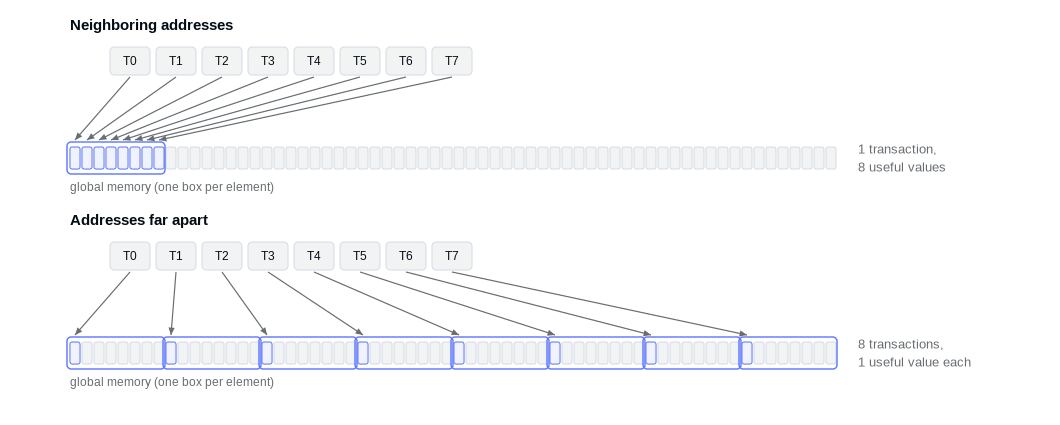
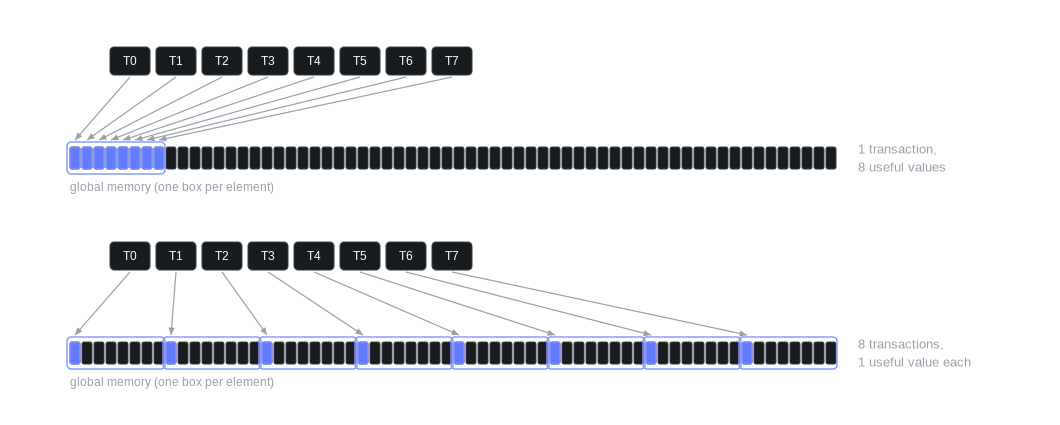
A matrix transpose shows the difference. The naive_transpose() kernel reads
a row of the input and writes it into a column of the output:
def naive_transpose(
    input: ImmTileTensor[dtype, type_of(matrix_layout), ImmUntrackedOrigin],
    output: MutTileTensor[dtype, type_of(matrix_layout), MutUntrackedOrigin],
):
    comptime assert input.flat_rank == 2 and output.flat_rank == 2
    var col = block_idx.x * TILE + thread_idx.x
    var row = block_idx.y * TILE + thread_idx.y
    comptime for i in range(0, TILE, ROWS_PER_PASS):
        # The read walks a row, but the write walks a column: consecutive
        # threads store SIZE elements apart.
        output[col, row + i] = input[row + i, col]
The reads are contiguous, but neighboring threads write addresses SIZE
elements apart, so each write needs its own transaction. The next section
removes the scattered writes by staging the data in shared memory.
Stage a tile in shared memory
The staged_transpose() kernel transposes the same matrix with contiguous
reads and writes. Each block loads a 32×32 tile of the input into shared
memory along rows, waits until the whole tile is there, and then writes it to
the output, again along rows. The transpose itself happens in shared memory,
where scattered access costs less.
The kernel uses all three common kinds of memory. Its arguments point into
global memory, tile is the shared-memory allocation shown earlier, and the
index variables such as tx and in_row live in registers:
def staged_transpose(
    input: ImmTileTensor[dtype, type_of(matrix_layout), ImmUntrackedOrigin],
    output: MutTileTensor[dtype, type_of(matrix_layout), MutUntrackedOrigin],
):
    comptime assert input.flat_rank == 2 and output.flat_rank == 2
    # One extra element per row shifts each row of the tile by one bank, which
    # spreads the column reads in the second loop across banks.
    var tile = stack_allocation[dtype, address_space=.SHARED](
        row_major[TILE, TILE + 1]()
    )
    comptime assert tile.flat_rank == 2

    var tx = thread_idx.x
    var ty = thread_idx.y
    var in_col = block_idx.x * TILE + tx
    var in_row = block_idx.y * TILE + ty
    comptime for i in range(0, TILE, ROWS_PER_PASS):
        tile[ty + i, tx] = input[in_row + i, in_col]

    # Every thread reads values that other threads wrote.
    barrier()

    # Swap the block coordinates so the write also walks a row of `output`.
    var out_col = block_idx.y * TILE + tx
    var out_row = block_idx.x * TILE + ty
    comptime for i in range(0, TILE, ROWS_PER_PASS):
        output[out_row + i, out_col] = tile[tx, ty + i]
A shared-memory allocation belongs to the thread block, not to the code block that declares it. Each thread block gets its own copy when it starts running, every thread in the block sees that copy, and the hardware releases it when the block finishes. Its contents start out undefined, and nothing in it carries over to another block or another launch.
In the second loop, each thread reads elements of tile that other threads
wrote in the first loop. The threads in a block don't run in lockstep, so
without a barrier() between the loops
a thread could read an element before its writer has stored it. For the rules
on when you need a barrier, see
Block and warp operations and synchronization.
Avoid bank conflicts
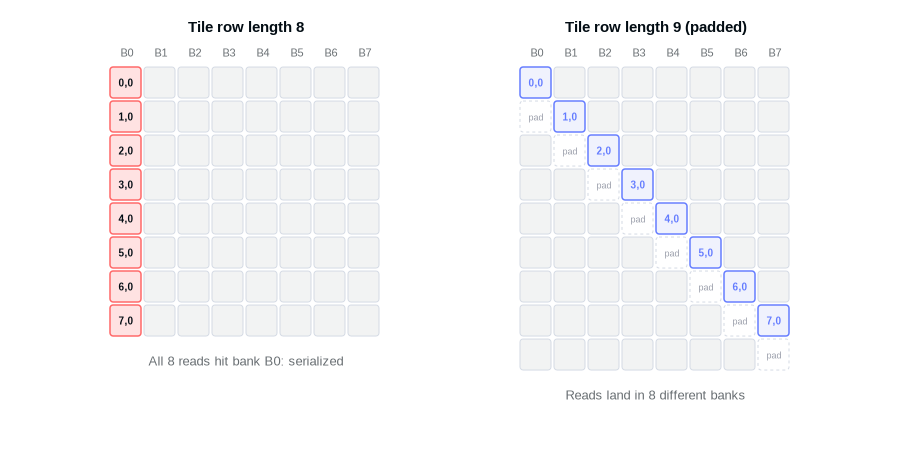
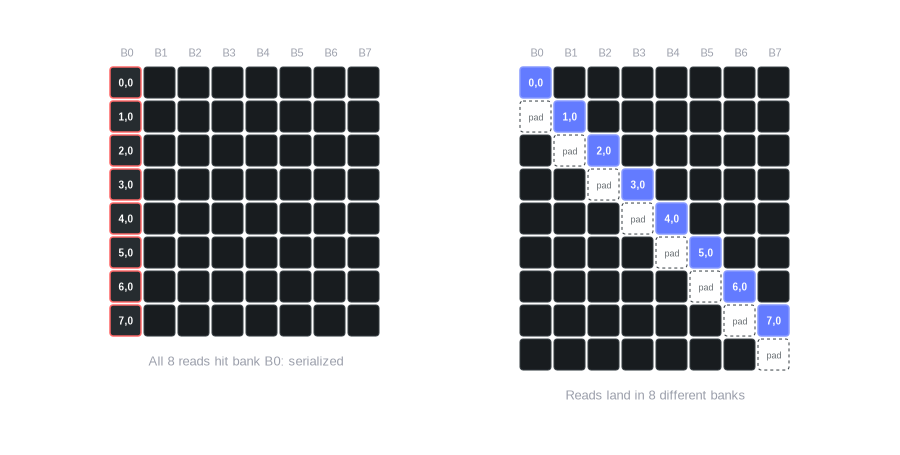
Shared memory has its own access rule. It's divided into banks, and when threads
access different addresses in the same bank at the same time, the hardware
serializes their accesses. Reading a column of a 32-element-wide tile can put
every element in the same bank, so the shared tile in staged_transpose() has
one extra column: each row starts one bank later than the row above it, which
spreads a column across banks. The number of banks varies by GPU, so treat the
padding as a starting point and confirm it with a profiler on your target.
Store narrow, compute wide
The data type you store determines how many bytes every copy and every global
load moves. A common technique is to keep data in a narrow type such as
bfloat16 in memory and widen it to float32 in registers for the arithmetic.
The scale() kernel in
host_device_movement.mojo
does this:
def scale(
    input: ImmTileTensor[storage_dtype, type_of(layout), ImmUntrackedOrigin],
    output: MutTileTensor[storage_dtype, type_of(layout), MutUntrackedOrigin],
):
    comptime assert input.flat_rank == 1 and output.flat_rank == 1
    var i = global_idx.x
    if i < SIZE:
        var x = input[i].cast[compute_dtype]()
        output[i] = (x * SCALE).cast[storage_dtype]()
Each bfloat16 value is half the size of a float32, so the copies and the
global loads move half as many bytes, while the multiplication runs at
float32 precision.
Host and device memory
The host is the CPU and the device is the GPU. On most systems each has its own memory, so you have to copy data to the device before a kernel can use it and copy it back before the host can read the results.
In Mojo, a
DeviceContext
allocates a DeviceBuffer in global memory and a HostBuffer in host memory,
and copies data between them. Each enqueue_ call adds an operation to the
queue and returns immediately. Queued operations run in order, so a kernel
launched after a copy sees the copied data, and the host must call
synchronize()
before it reads anything the device wrote. This code copies an input to the
device, runs scale() on it, and copies the result back:
    # Copies and the kernel run in order on the context's stream.
    ctx.enqueue_copy(dev_in, host_in)
    ctx.enqueue_function[scale](
        TileTensor(dev_in, layout).as_imm(),
        TileTensor(dev_out, layout),
        grid_dim=ceildiv(SIZE, BLOCK_SIZE),
        block_dim=BLOCK_SIZE,
    )
    ctx.enqueue_copy(host_out, dev_out)
    # The host must wait before it reads what the device wrote.
    ctx.synchronize()
For allocating buffers, copying between them, and when Mojo frees them, see GPU programming fundamentals.
Unified memory
On some systems the CPU and GPU share one physical pool of memory. Apple silicon
works this way, and so do AMD Ryzen AI Max processors such as Strix Halo, whose
CPU and GPU memory is
physically shared,
and NVIDIA DGX Spark. To check a device, call
is_host_unified()
on its Device, as in ctx.device().is_host_unified(). It returns True on
these systems, and False on GPUs with their own memory, such as the NVIDIA
B200 and AMD MI355X. The calls on this page work the same on every system, so
the same program runs whether or not the memory is unified.
Unified memory doesn't mean the GPU can use all of the host's memory.
get_memory_info()
reports the memory the GPU can map, which can be less than the machine has. On
Strix Halo, for example, Linux lets the GPU map about half of system RAM by
default.
Separately, some Linux systems with NVIDIA GPUs support
heterogeneous memory management
(HMM), which lets a kernel read ordinary host memory. HMM needs a Turing or
newer GPU, NVIDIA's open kernel modules with driver 535 or later, and a recent
Linux kernel. To see whether a system has it, run nvidia-smi -q and look for
Addressing Mode : HMM. On those systems a kernel that mistakenly reads a host
address can appear to work, and then fail on a GPU without HMM. Make sure your
tests check results, and test on more than one system when you can.
Hardware-specific memory
Some memory exists only on certain GPUs, such as tensor memory on NVIDIA Blackwell GPUs. The architecture guides cover these features.
Next steps
- GPU programming fundamentals covers device buffers, host buffers, and copies in more detail.
- Block and warp operations and synchronization explains synchronization and shared memory in a tiled matrix multiplication.
- Using TileTensor shows how to build and tile the tensors used on this page.